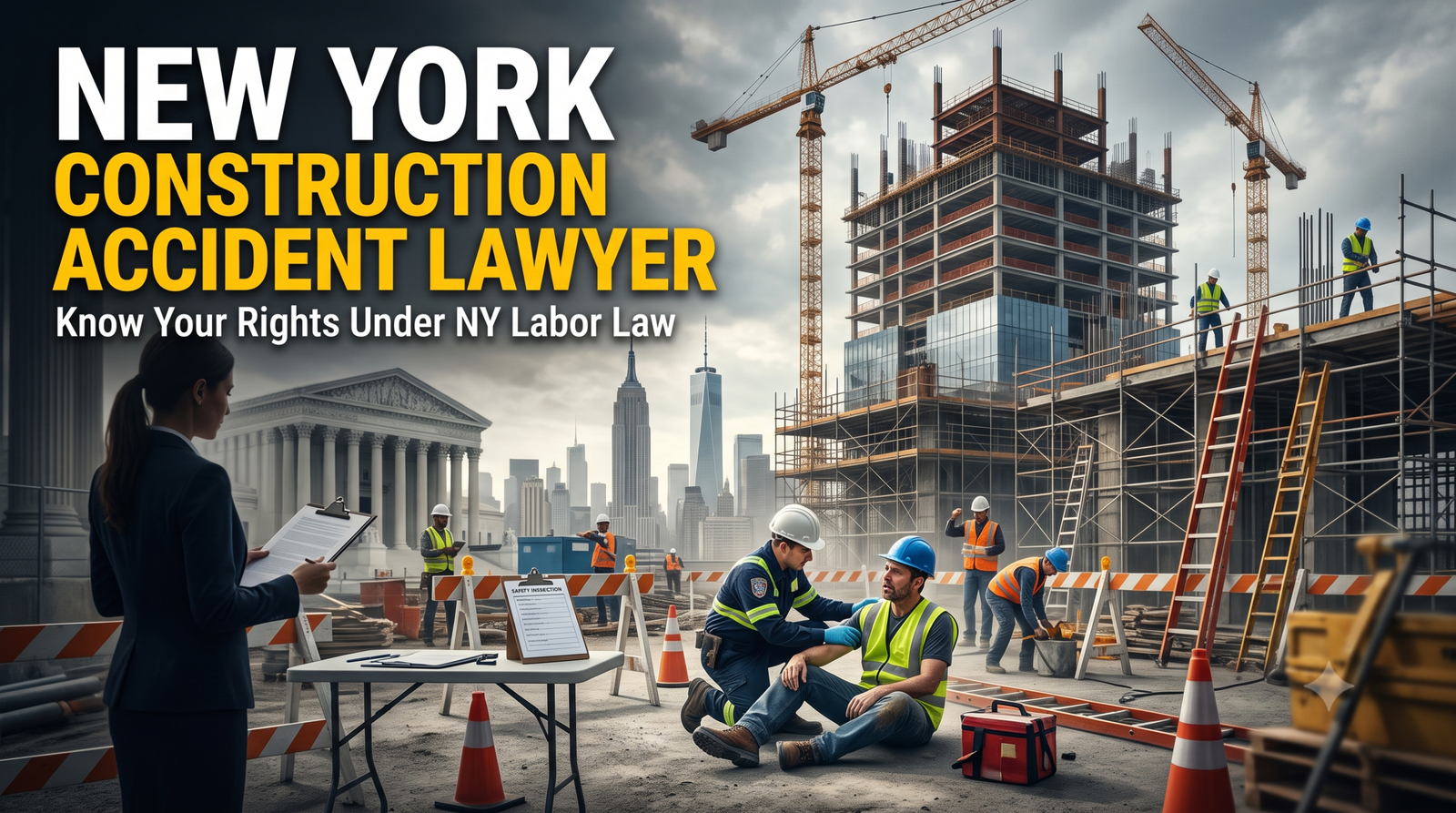
Construction work keeps New York moving. From skyscrapers and apartment buildings in Manhattan to road projects, bridges, and developments across Long Island and upstate New York, thousands of workers spend their days doing physically demanding and sometimes dangerous jobs.
Unfortunately, accidents happen.
A fall from scaffolding. A ladder that suddenly gives way. A worker struck by falling materials. A crane accident. An electrical injury. A trench collapse.
For an injured construction worker, the accident itself may last only seconds. The consequences can continue for months or even years.
If you were injured while working on a New York construction site, you may be wondering: Who is responsible? Can I receive workers’ compensation? Can I sue the property owner or general contractor? What happens if I was partly at fault?
The answers depend on the circumstances of your accident. New York construction injury law is also different from the rules that apply in many other states.
What Should You Do After a Construction Accident in New York?
Your health should come first.
After a serious construction accident, try to take these steps as soon as you reasonably can:
- Get medical attention immediately.
- Report the accident to your employer or supervisor.
- Take photographs of the accident scene if it is safe to do so.
- Write down the names of witnesses.
- Keep copies of medical records and accident reports.
- Don’t sign a settlement or release without understanding it.
- Speak with a New York construction accident attorney if your injuries are significant.
Construction sites change quickly. Equipment may be repaired, debris may be removed, and dangerous conditions may disappear.
That can make early evidence preservation extremely important.
Workers’ Compensation Isn’t Always the End of the Story
If you are injured while working, workers’ compensation may provide important benefits, including medical treatment and wage-related benefits.
But workers’ compensation generally does not provide the same types of damages available in a personal injury lawsuit. For example, traditional workers’ compensation benefits generally don’t compensate an injured worker for pain and suffering in the same way a third-party personal injury claim can.
This is where New York construction accident cases can become complicated.
You may be prohibited from suing your direct employer for ordinary negligence because of workers’ compensation’s exclusive-remedy rules. However, other parties may potentially be held responsible when their negligence or statutory violations contributed to your injuries.
Those parties could include a property owner, general contractor, subcontractor, equipment manufacturer, or another company involved with the project.
New York Labor Law: Why It Matters After a Construction Injury
New York has several laws that provide important protections to construction workers.
Three provisions are particularly important in many construction accident cases: Labor Law §§ 240(1), 241(6), and 200.
New York Labor Law § 240(1): The Scaffold Law
You’ve probably heard the phrase “Scaffold Law.”
Labor Law § 240(1) addresses certain elevation-related risks faced by construction workers.
It can apply to accidents involving falls from elevated surfaces or workers being struck by objects that fall from an elevated position, depending on the circumstances.
Examples can include:
- Falls from scaffolds
- Ladder falls
- Roof falls
- Falls from elevated platforms
- Certain hoist-related accidents
- Workers struck by falling construction materials
Section 240(1) places specific safety responsibilities on covered owners and contractors.
Importantly, not every construction accident automatically qualifies as a Section 240(1) claim. The circumstances of the accident matter, including whether the injury resulted from the type of elevation-related hazard covered by the statute.
If Section 240(1) applies, it can provide a powerful basis for a worker’s claim.
Labor Law § 241(6): Construction Site Safety Rules
Labor Law § 241(6) concerns construction, excavation, and demolition work and requires covered owners and contractors to provide workers with reasonable and adequate protection.
Claims under this section often involve alleged violations of specific New York Industrial Code provisions.
For example, an attorney may investigate whether regulations concerning:
- Safe walkways
- Excavation and trenches
- Ladders
- Scaffolding
- Machinery
- Protective equipment
- Electrical hazards
- Falling objects
were followed.
A successful § 241(6) claim generally requires more than simply showing that a construction site was dangerous. The particular Industrial Code provision and facts surrounding the violation are important.
Labor Law § 200: The General Safety Requirement
Labor Law § 200 addresses workplace safety and codifies aspects of common-law negligence.
Depending on the circumstances, an owner or contractor may face liability where a dangerous condition existed on the property or where the party exercised sufficient control over the work that caused the injury.
These cases can involve detailed questions about who knew about the dangerous condition, who created it, and who had authority over the work.
Common Construction Accidents in New York
Construction injuries can happen in many ways. Some of the most common include:
Scaffold Accidents
Scaffolds must be properly constructed, maintained, and used. A fall caused by an unsafe scaffold or inadequate protection can result in devastating injuries.
Ladder Falls
A defective, unsecured, improperly positioned, or inappropriate ladder can create a serious fall hazard.
Falling Objects
Tools, concrete, steel, equipment, and other materials can fall from elevated locations and strike workers below.
Crane and Heavy Equipment Accidents
Cranes, forklifts, excavators, lifts, and other heavy machinery can cause catastrophic injuries when improperly operated, maintained, or secured.
Trench Collapses
Excavation work presents serious risks. A trench collapse can happen quickly and leave workers with little opportunity to escape.
Electrical Accidents
Contact with live wires, electrical equipment, or overhead power lines can cause severe burns, electrocution, and other life-changing injuries.
Slip, Trip, and Fall Accidents
Construction sites often contain debris, uneven surfaces, holes, exposed materials, slippery areas, and unfinished flooring.
Not every accident falls under the same section of New York Labor Law. The specific facts are critical.
Who Can Be Held Responsible for a Construction Accident?
One of the most important parts of a construction injury investigation is determining who had responsibility for the hazard.
Potentially responsible parties may include:
- Property owners
- General contractors
- Construction managers
- Subcontractors
- Equipment owners
- Equipment manufacturers
- Maintenance companies
- Other contractors working at the site
For example, imagine a worker falls because a scaffold lacks required safety protection.
The worker’s employer may be responsible for workers’ compensation benefits, while another party may potentially face a separate personal injury claim depending on its legal duties and the facts.
That is why identifying every company involved in the project can be important.
What If You Were Partly at Fault?
Many injured workers worry about this question:
“What if I made a mistake too?”
Don’t automatically assume that a mistake means you have no legal claim.
New York personal injury law generally uses comparative-fault principles in many negligence cases. However, certain Labor Law § 240(1) claims are treated differently when the statute applies.
The effect of a worker’s conduct can therefore depend heavily on the specific legal theory involved.
An attorney will typically examine what happened, what safety equipment was provided, what instructions were given, and whether the accident resulted from a covered safety violation or dangerous condition.
Can Undocumented Workers File Construction Injury Claims in New York?
Immigration status does not automatically eliminate an injured worker’s rights under New York labor and personal injury laws.
New York courts have addressed the rights of undocumented workers in construction-related injury cases, including issues involving damages.
If you’re concerned about your immigration status, don’t assume that you cannot speak with an attorney or pursue a legitimate workplace injury claim.
A qualified New York attorney can explain how the facts of your particular situation may affect your case.
How Much Is a New York Construction Accident Claim Worth?
There is no standard settlement amount.
Two workers could suffer seemingly similar accidents but have completely different claims.
Potential damages may include:
- Medical expenses
- Future medical treatment
- Rehabilitation
- Lost wages
- Reduced earning capacity
- Physical pain
- Emotional suffering
- Permanent disability
- Disfigurement
- Loss of enjoyment of life
- Other legally recoverable losses
The seriousness of the injury is only one part of the equation. Liability, insurance coverage, applicable statutes, future medical needs, employment history, and other factors can influence the value of a claim.
Be cautious about any lawyer or website promising a specific settlement before investigating your case.
New York Construction Accident Lawsuits Have Deadlines
Timing matters.
For many personal injury claims against private parties, New York generally provides a three-year statute of limitations, although exceptions can apply.
Claims involving public entities can have substantially different requirements. For example, certain claims may require a Notice of Claim within 90 days.
Wrongful death claims also have their own deadlines and requirements.
Because the applicable deadline depends on the identity of the defendant and the nature of the claim, don’t wait until the last minute to seek legal advice.
Why Talk to a New York Construction Accident Lawyer?
After a serious construction injury, you may be dealing with doctors, bills, lost income, rehabilitation, and pressure from insurance companies.
A construction accident attorney can investigate the accident while you focus on recovering.
Depending on the case, an attorney may:
- Inspect the accident location
- Identify potentially responsible parties
- Review contracts between companies
- Gather photographs and video
- Obtain construction records
- Review safety documentation
- Investigate equipment maintenance
- Analyze applicable Labor Law provisions
- Identify available insurance coverage
- Consult accident reconstruction or medical experts
- Handle communications with insurers
- Pursue a settlement or lawsuit when appropriate
The goal isn’t simply to file paperwork. It’s to understand why the accident happened, who may be legally responsible, and what compensation may be available under the law.
Frequently Asked Questions
Do I need a lawyer for a construction accident in New York?
Not every workplace injury requires a personal injury lawsuit. However, if you suffered serious injuries or believe someone other than your employer may have caused the accident, speaking with a construction accident attorney can help you understand your options.
Can I receive workers’ compensation and sue another company?
Potentially. Workers’ compensation and a third-party personal injury claim can sometimes exist at the same time. Whether you have a third-party claim depends on the facts and the identity of the potentially responsible party.
What is the New York Scaffold Law?
The term “Scaffold Law” commonly refers to New York Labor Law § 240(1), which addresses certain elevation-related construction risks, including qualifying falls and falling-object accidents.
Can I sue after falling from a ladder at work?
Possibly. A ladder accident may involve Labor Law § 240(1), § 200, § 241(6), workers’ compensation, or other legal theories depending on how and why the accident occurred.
What if the construction company says the accident was my fault?
The company’s statement does not necessarily determine legal responsibility. Evidence and the applicable law matter. Avoid making assumptions about your claim before the accident has been properly investigated.
Final Thoughts
A construction accident can leave you facing much more than a medical bill. A serious injury can affect your ability to work, your family, your finances, and your plans for the future.
If you’ve been injured on a New York construction site, don’t assume that workers’ compensation is your only potential source of recovery.
New York’s Labor Law provides important protections for qualifying construction workers, and a third-party lawsuit may be possible in certain circumstances.
The sooner you understand your rights, the easier it may be to preserve important evidence and make informed decisions.
If your injury was serious, consider speaking with a New York construction accident lawyer who can review the circumstances of your accident and explain which legal options may apply.
Legal Disclaimer: This article is intended for general informational and educational purposes only. It is not legal advice and does not create an attorney-client relationship. New York construction accident law is highly fact-specific, and statutes, regulations, and deadlines may change. If you have been injured, consult a New York attorney about your individual circumstances.